
Stainless Steel Access Panel Commercial Kitchen: 2026 Guide

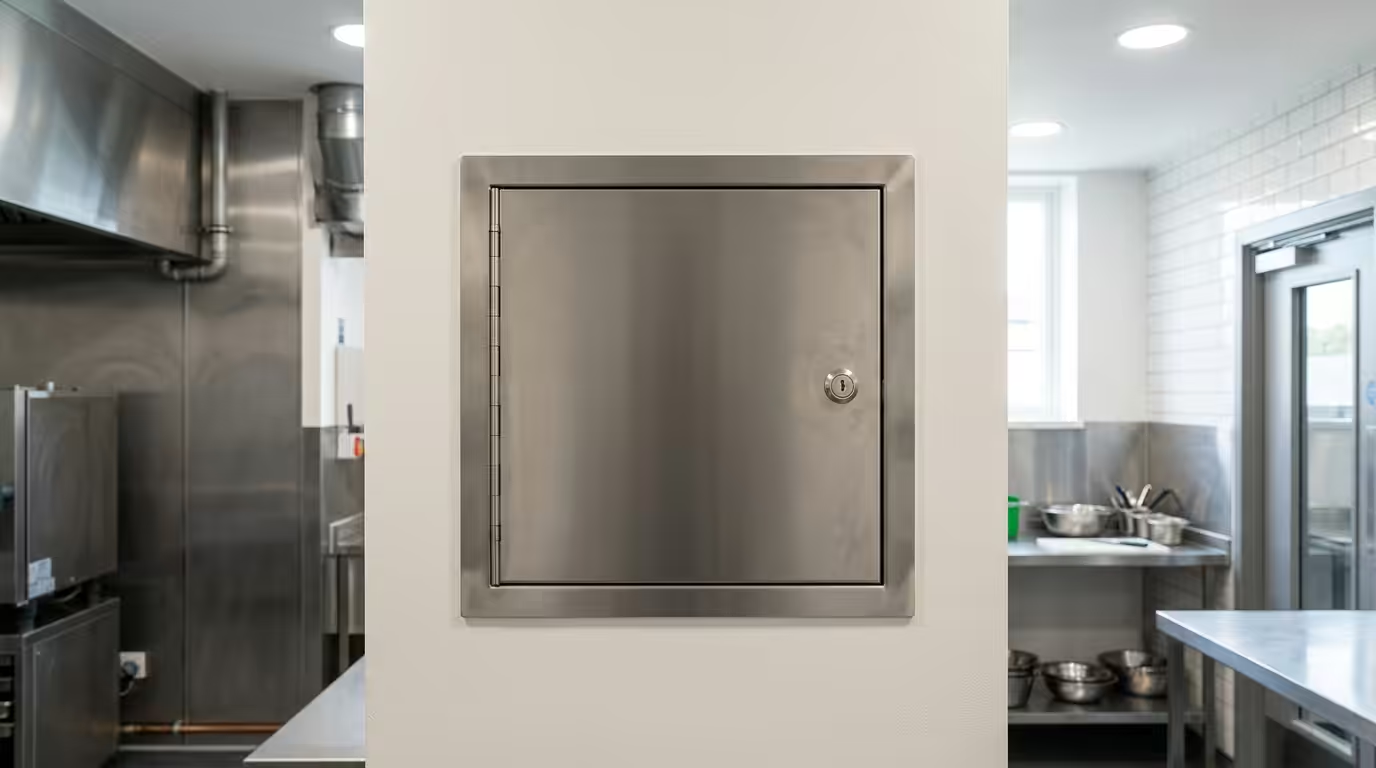
Stainless Steel Access Panels for Commercial Kitchens: Complete Professional Guide
Stainless steel access panels in commercial kitchens provide essential maintenance access while meeting stringent food safety and fire safety requirements. Grade 316 stainless steel panels offer superior corrosion resistance in high-humidity environments, with fire ratings up to 120 minutes when required. Professional kitchen installations demand compliance with Building Regulations Part B, food hygiene standards, and HACCP protocols.
Commercial kitchen access panels serve critical functions: concealing utility connections, providing service access to equipment, and maintaining hygienic surfaces. The global commercial kitchen equipment market, valued at £45.2 billion in 2025, increasingly specifies stainless steel access solutions for their durability and cleanability. This guide examines technical specifications, regulatory compliance, and installation best practices for professional kitchen environments.
Material Specifications and Food Safety Compliance
Stainless Steel Grades for Kitchen Applications
Grade 316 stainless steel remains the industry standard for commercial kitchen access panels, offering enhanced corrosion resistance through molybdenum content. This austenitic steel contains 2-3% molybdenum, providing superior performance against chlorides and acidic cleaning agents common in professional kitchens. Grade 304 stainless steel, while more economical, lacks adequate resistance to commercial kitchen environments and aggressive sanitising chemicals.
Surface finishes critically impact hygiene performance. 2B mill finish provides adequate smoothness for most applications, while 2R cold-rolled finish offers enhanced cleanability for food preparation areas. Brush finishes (4 grade) hide minor scratches but create microscopic crevices that can harbour bacteria, making them unsuitable for direct food contact zones.
Food Safety Standards and HACCP Requirements
Commercial kitchen access panels must comply with Food Standards Agency guidance and HACCP (Hazard Analysis Critical Control Points) principles. Panels require smooth, non-porous surfaces that resist bacterial growth and allow effective sanitisation. Crevice-free construction eliminates potential contamination harbourage points, while gasket materials must achieve FDA food-grade certification.
Temperature resistance proves essential in commercial kitchens, where ambient temperatures regularly exceed 40°C near cooking equipment. Stainless steel panels maintain structural integrity and dimensional stability across temperature ranges from -20°C to +200°C, accommodating thermal cycling from refrigeration areas to cooking zones.
Fire Safety and Building Regulations Compliance
Fire Rating Requirements
Building Regulations Part B mandates specific fire resistance periods for kitchen service areas. Access panels in commercial kitchens typically require 30-60 minute fire ratings, with 120-minute ratings specified for high-risk areas or large commercial facilities. Fire-rated stainless steel panels incorporate intumescent seals that expand under heat exposure, maintaining compartmentation integrity.
BS EN 1634-1 governs fire resistance testing for access panels, measuring integrity (E), insulation (I), and radiation (W) criteria. Commercial kitchen panels must achieve EI classification as minimum requirement, preventing flame penetration and limiting temperature rise on the non-fire side.
Ventilation and Smoke Control Integration
Access panels in commercial kitchens often integrate with mechanical ventilation systems and smoke extraction equipment. Panel design must accommodate ductwork access while maintaining fire compartmentation. Sleeve seals and firestopping systems require careful specification to prevent smoke leakage paths while allowing maintenance access.
Kitchen extract systems operating at negative pressures can affect panel performance. Magnetic latching mechanisms provide secure closure against pressure differentials, while continuous gasket systems prevent air leakage that could compromise kitchen ventilation balance.
Installation Considerations and Maintenance Access
Utility Service Integration
Commercial kitchen access panels typically conceal multiple utility services: gas supplies, electrical installations, water services, and drainage connections. Panel sizing must accommodate service routing while providing adequate working space for maintenance personnel. Minimum clear opening dimensions of 600mm × 600mm allow technician access for equipment servicing.
Gas service access requires particular attention to safety protocols. Panels serving gas installations must incorporate leak detection considerations and emergency isolation access. Electrical services behind panels need adequate clearance for safe working, following BS 7671 (18th Edition) requirements for maintenance access in commercial premises.
Cleaning and Sanitisation Protocols
Daily cleaning protocols in commercial kitchens demand robust panel construction. Stainless steel surfaces must withstand aggressive cleaning chemicals including quaternary ammonium compounds, chlorine-based sanitisers, and alkaline degreasers. Welded construction eliminates crevices where cleaning residues might accumulate.
Panel design should facilitate rapid cleaning during service breaks. Flush-mounted installations with minimal projection reduce cleaning time and improve workflow efficiency. Magnetic catches eliminate protruding hardware that complicates sanitisation procedures.
| Panel Feature | Food Safety Benefit | Maintenance Advantage | Regulatory Compliance |
|---|---|---|---|
| 316 Grade Stainless Steel | Superior corrosion resistance | Extended service life | FDA food-grade materials |
| Welded Construction | Eliminates bacterial harbourage | Structural integrity | HACCP compliance |
| Magnetic Latching | Secure closure | Easy access without tools | Pressure differential resistance |
| Fire-rated Seals | Prevents contamination spread | Protects services during fire | Building Regulations Part B |
Cost Analysis and Specification Guidance
Economic Considerations
Stainless steel access panels represent higher initial investment compared to standard steel alternatives, typically 40-60% premium over powder-coated options. However, lifecycle cost analysis demonstrates superior value through extended service life and reduced maintenance requirements. Commercial kitchen environments demand panel replacement every 8-12 years for standard materials versus 15-20 years for quality stainless steel installations.
Labour costs for panel replacement in operational kitchens often exceed material costs due to service disruption and deep cleaning requirements. Specifying durable stainless steel panels reduces long-term operational costs through extended replacement intervals and simplified maintenance protocols.
Specification Best Practices
Professional kitchen designers should specify panel locations during design development to optimise service access and cleaning protocols. Fire-rated access panels require early specification to coordinate with structural fire protection and MEP installations.
Panel sizing should consider future equipment modifications and service upgrades. Standard commercial sizes (600×600mm, 800×800mm) provide cost advantages through volume production, while bespoke access panels accommodate specific design requirements and unusual service configurations.
Summary
- Grade 316 stainless steel provides essential corrosion resistance against commercial kitchen chemicals and humidity, significantly outperforming Grade 304 alternatives in professional environments.
- Fire-rated panels must achieve EI classification under BS EN 1634-1 testing, with 30-60 minute ratings typically required for commercial kitchen applications under Building Regulations Part B.
- Food safety compliance requires smooth, non-porous surfaces, welded construction, and FDA-approved gasket materials to meet HACCP principles and Food Standards Agency guidance.
- Proper panel sizing (minimum 600×600mm clear opening) ensures adequate maintenance access for gas, electrical, water, and drainage services while accommodating technician working space requirements.
- Lifecycle cost analysis demonstrates 15-20 year service life for quality stainless steel panels versus 8-12 years for standard alternatives, offsetting 40-60% higher initial costs through reduced replacement frequency.
Frequently Asked Questions
What fire rating do I need for access panels in commercial kitchens?
Commercial kitchen access panels typically require 30-60 minute fire ratings under Building Regulations Part B. High-risk areas or large facilities may specify 120-minute ratings. Fire-rated panels must achieve EI classification, preventing flame penetration and limiting temperature rise.
Can stainless steel access panels withstand commercial kitchen cleaning chemicals?
Grade 316 stainless steel panels resist quaternary ammonium compounds, chlorine-based sanitisers, and alkaline degreasers commonly used in commercial kitchens. The molybdenum content provides superior chemical resistance compared to Grade 304 stainless steel.
What size access panel do I need for kitchen equipment maintenance?
Minimum clear opening dimensions of 600×600mm accommodate technician access for most kitchen equipment servicing. Larger panels (800×800mm or custom sizes) may be required for major equipment access or multiple utility services.
How do access panels maintain food safety standards?
Food-safe access panels require smooth, non-porous stainless steel surfaces, welded construction to eliminate crevices, and FDA-approved gasket materials. This design prevents bacterial harbourage and enables effective sanitisation protocols required under HACCP principles.
Do magnetic catches work reliably in commercial kitchen environments?
Magnetic latching systems provide secure closure against kitchen ventilation pressure differentials while enabling tool-free access. Stainless steel magnetic assemblies resist corrosion and maintain holding strength in high-humidity commercial kitchen environments.