
Access Panel External IP65 Weatherproof: Complete Guide 2026

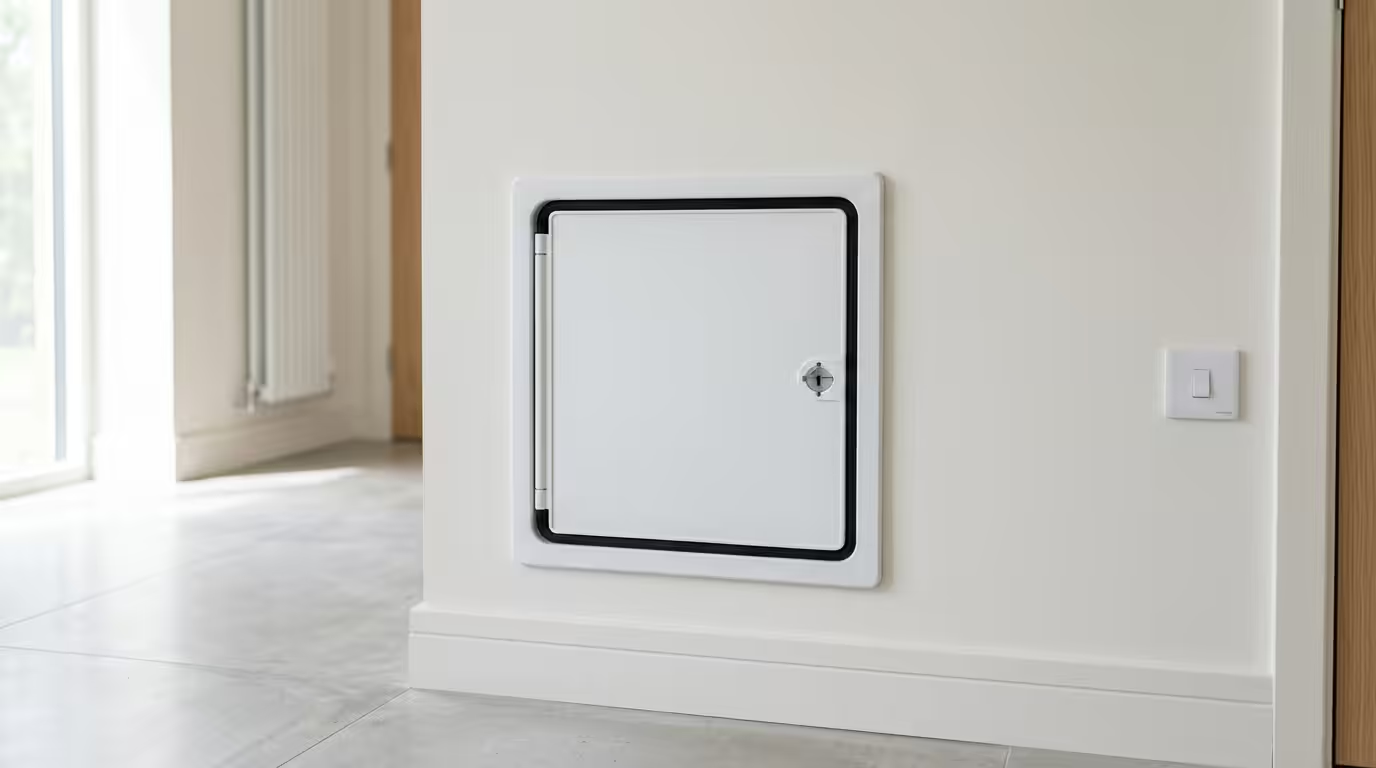
Access Panel External IP65 Weatherproof: Complete Specification Guide
An IP65 weatherproof access panel provides complete protection against dust ingress and water jets from any direction, making it the minimum standard for external building applications. With IP65 rating offering dust-tight sealing and protection against 12.5 litres per minute water jets at 3-bar pressure, these panels ensure reliable access to utilities whilst maintaining weather resistance. This comprehensive guide examines specification requirements, installation standards, and regulatory compliance for external weatherproof access solutions.
External access panels face unique challenges including thermal cycling between -20°C to +80°C, UV degradation, and mechanical stress from building movement. Professional specification requires understanding of ingress protection standards, material selection, and Building Regulations Part L compliance for thermal bridging prevention.
IP Rating Standards and External Weather Protection
Understanding IP65 Protection Level
The IP65 rating combines two critical protection elements: complete dust protection (level 6) and water jet resistance (level 5). For external applications, this translates to absolute dust-tight performance preventing any particulate ingress, whilst withstanding water projected from 6.3mm nozzles at 12.5 litres per minute from any angle.
Testing procedures follow BS EN 60529:1992, requiring continuous 15-minute water jet exposure from all directions. The dust test involves 8 hours in a dust chamber with talcum powder circulation, followed by internal inspection confirming zero contamination.
Weatherproofing Requirements for Building Exteriors
External weatherproof panels must address multiple environmental challenges beyond basic IP rating requirements. Wind-driven rain can generate pressures exceeding 1,200 Pa according to BS 8104, requiring enhanced sealing systems. Temperature cycling creates expansion-contraction stresses demanding flexible gasket materials maintaining seal integrity across -30°C to +70°C operational ranges.
UV resistance becomes critical for south-facing installations, with ABS and polycarbonate materials requiring UV stabilisers preventing degradation over 25-year service life. Galvanic corrosion protection requires careful material selection, particularly where dissimilar metals interface with building fabric.
Material Specifications and Construction Standards
Frame and Door Construction Materials
Aluminium alloy construction typically utilises 6063-T6 grade providing 160-190 MPa tensile strength whilst maintaining corrosion resistance through natural oxide formation. Wall thickness specifications require minimum 2.5mm for external applications, increasing to 3mm for panels exceeding 600mm x 600mm dimensions.
Stainless steel alternatives employ 316L grade for coastal environments, offering superior chloride resistance. Powder coating systems require minimum 80-micron thickness applied over chromate conversion treatment, achieving 1,000-hour salt spray resistance per BS EN ISO 9227.
Sealing System Components
Primary sealing employs EPDM rubber gaskets with 70±5 Shore A hardness, maintaining flexibility across temperature extremes. Gasket profiles require 15-25% compression generating 150-300N/m sealing force. Secondary weather sealing often incorporates expanding foam tapes achieving 5-10mm compression range.
Compression latch mechanisms must generate minimum 400N closing force ensuring consistent gasket compression. Stainless steel cam locks with adjustable compression provide optimal field adjustment capability addressing building movement and thermal expansion.
Installation Requirements and Building Regulations
Building Regulations Compliance
Part L requirements mandate thermal bridging assessment where access panels penetrate insulation layers. Thermally broken frame construction reduces linear thermal transmittance (Ψ-values) to below 0.02 W/mK. Insulated panel cores utilising polyurethane foam achieve U-values matching surrounding wall construction, typically 0.18-0.25 W/m²K.
Part B fire safety considerations require non-combustible materials for buildings exceeding 18m height. Aluminium construction satisfies Class A1 requirements, whilst fire-rated variants achieve up to 120 minutes integrity per BS EN 1634-1 testing.
Structural Integration and Fixing Methods
Wall mounting requires mechanical fixings achieving minimum 2.0kN pull-out resistance per fixing point. Stainless steel expansion bolts or chemical anchors provide suitable performance in masonry construction. Structural calculations must account for wind loading per BS EN 1991-1-4, typically generating 1.5-2.5kN/m² pressure on vertical surfaces.
Cavity wall installations require careful DPC integration preventing water ingress paths. Flexible DPC materials lap minimum 150mm beyond panel frame, with sealed joints using compatible sealants. Thermal movement joints accommodate ±10mm expansion using flexible sealant systems maintaining weatherproof integrity.
| Panel Size | Maximum Wind Load (Pa) | Minimum Frame Thickness (mm) | Required Fixings | Thermal Performance (W/m²K) |
|---|---|---|---|---|
| 300x300mm | 2,400 | 2.5 | 4 corners | 0.18-0.22 |
| 450x450mm | 2,000 | 2.5 | 6 perimeter | 0.20-0.24 |
| 600x600mm | 1,800 | 3.0 | 8 perimeter | 0.22-0.26 |
| 900x600mm | 1,500 | 3.0 | 10 perimeter | 0.24-0.28 |
Application-Specific Considerations
Utility Access and Service Integration
External utility access panels frequently house gas meters, electrical distribution equipment, and telecommunications infrastructure. Each application demands specific dimensional requirements following utility company standards. Gas meter housings require minimum 150mm clearance around equipment with natural ventilation provisions per Gas Safety (Installation and Use) Regulations.
Electrical applications must satisfy BS 7671 requirements for IP rating selection based on external influences. Coastal locations (AD2) mandate minimum IP65 protection, whilst normal outdoor conditions (AD4) permit IP54 ratings. Higher classifications become necessary for wash-down areas or severe industrial environments.
Maintenance Access and Operational Requirements
Service accessibility demands consideration of maintenance frequency and tool requirements. Quarterly meter readings necessitate easy-operation mechanisms suitable for personnel wearing protective equipment. Key-operated locks provide security whilst maintaining utility company access through standardised key systems.
Hinge design must accommodate full 180-degree opening preventing access restrictions in confined spaces. Corrosion-resistant hinges utilising bronze bushings or sealed ball bearings ensure smooth operation throughout 25-year design life. External access panel solutions require careful specification balancing security, accessibility, and weather protection.
Summary
- IP65 weatherproof rating provides dust-tight protection and resistance to 12.5 l/min water jets from any direction, meeting minimum external application standards
- Aluminium alloy construction requires minimum 2.5mm wall thickness with powder coating achieving 1,000-hour salt spray resistance per BS EN ISO 9227
- EPDM gasket sealing systems with 15-25% compression generate 150-300N/m sealing force maintaining weatherproof integrity across -30°C to +70°C
- Building Regulations Part L compliance demands thermally broken construction achieving Ψ-values below 0.02 W/mK and U-values matching wall performance
- Structural fixings must provide minimum 2.0kN pull-out resistance accounting for wind loads up to 2,400 Pa per BS EN 1991-1-4
For comprehensive weatherproofing solutions, consider our insulated access panel range offering enhanced thermal performance for energy-efficient building envelopes.
Frequently Asked Questions
What IP rating do I need for external access panels?
IP65 represents the minimum standard for external applications, providing complete dust protection and water jet resistance. Coastal or wash-down environments may require IP66 or IP67 ratings offering enhanced water protection against powerful jets or temporary immersion.
How do weatherproof access panels prevent thermal bridging?
Thermally broken frame construction incorporates polyamide thermal breaks reducing linear thermal transmittance to below 0.02 W/mK. Insulated panel cores with polyurethane foam achieve U-values matching surrounding wall construction, typically 0.18-0.25 W/m²K.
What maintenance intervals apply to external weatherproof panels?
Annual inspection of gasket condition and locking mechanisms prevents premature failure. Coastal installations require quarterly cleaning removing salt deposits. Gasket replacement typically occurs every 10-15 years depending on UV exposure and temperature cycling severity.
Can weatherproof access panels achieve fire ratings?
Fire-rated weatherproof panels achieve up to 120 minutes integrity per BS EN 1634-1 using intumescent sealing systems. Non-combustible aluminium construction satisfies Class A1 requirements for buildings exceeding 18m height under Building Regulations Part B.
What wind loads must external access panels withstand?
Wind load calculations per BS EN 1991-1-4 typically generate 1.5-2.5kN/m² pressure on vertical building surfaces. Panel sizing affects maximum allowable loads, with 300x300mm panels withstanding up to 2,400 Pa compared to 1,500 Pa for 900x600mm dimensions requiring enhanced frame thickness.